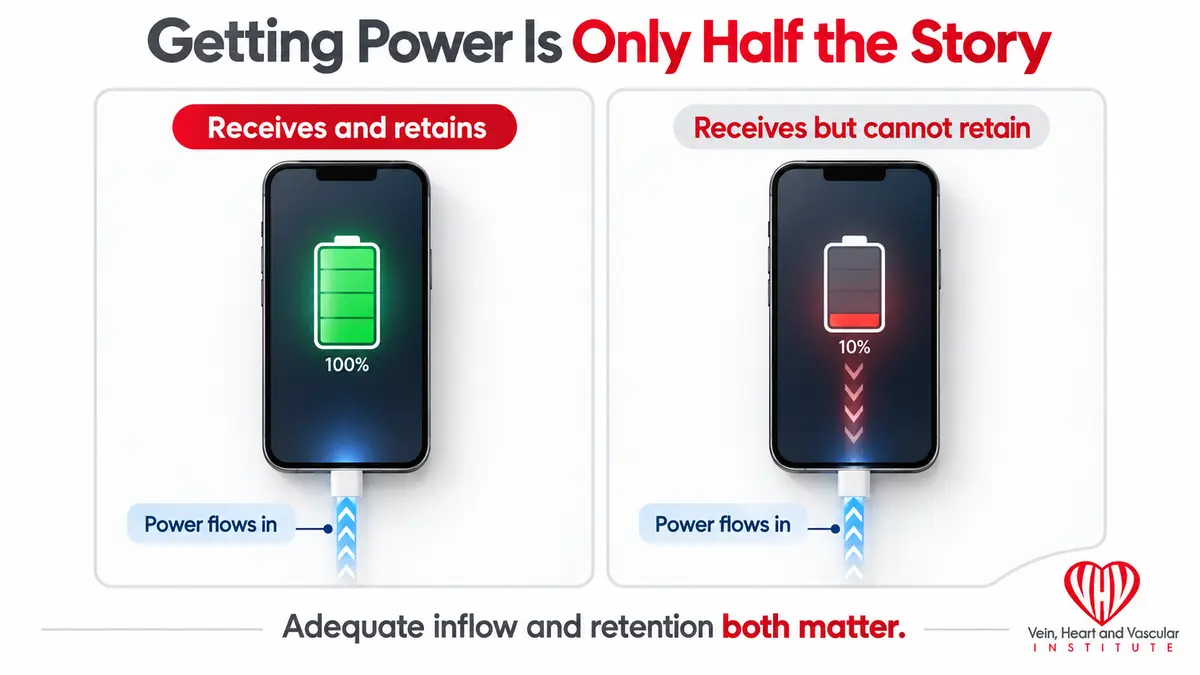
Erectile dysfunction (ED) is often described as a blood-flow problem. That is partly true—but blood flow into the penis is only one part of the process. Blood must also be retained within the erectile tissue. When retention is impaired, an erection may begin but lose firmness too soon.
How a normal erection works
During sexual stimulation, arteries supplying the penis relax and widen, allowing more blood to enter the corpora cavernosa—the paired erectile chambers. As these chambers expand, they compress the small veins that normally drain blood away. This veno-occlusive mechanism reduces outflow and helps maintain rigidity.
A firm erection therefore depends on two coordinated functions: adequate arterial inflow and adequate restriction of venous outflow.
Erectile dysfunction is not always poor arterial inflow
Some men have reduced arterial inflow related to cardiovascular disease, diabetes, smoking, prior pelvic treatment, or other factors. Others may have adequate inflow but difficulty retaining blood within the erectile tissue. In some patients, both problems are present.
This distinction matters because similar symptoms can arise from different causes, and the most appropriate evaluation or treatment may not be the same for every patient.
What is venous leak?
“Venous leak,” also called veno-occlusive dysfunction, describes impaired retention of blood during an erection. Blood enters the erectile tissue but is not trapped effectively enough to maintain firmness.
The term does not always mean that a single vein is defective. Veno-occlusive dysfunction can reflect changes in erectile tissue, abnormal venous drainage pathways, or a combination of vascular and nonvascular factors.
What symptoms can occur?
Men with suspected veno-occlusive dysfunction may report an erection that starts normally but loses rigidity, difficulty maintaining an erection during sexual activity, or an erection that is firmer in some circumstances than others.
Other causes of erectile dysfunction still matter
A complete assessment considers the broader picture. Erectile dysfunction may be associated with cardiovascular risk factors, diabetes, low testosterone or other hormonal abnormalities, medication effects, sleep disorders, pelvic surgery or radiation, neurologic conditions, anxiety, depression, relationship factors, and lifestyle influences.
Because ED can be multifactorial, identifying one possible vascular finding does not eliminate the need to consider other contributors.
Evaluation begins with the whole patient
A careful evaluation starts with a medical and sexual history, medication review, cardiovascular risk assessment, and focused examination. Laboratory testing may be appropriate depending on the individual. The goal is not simply to label symptoms, but to determine which factors may be contributing and whether vascular testing is likely to add useful information.
How is vascular erectile dysfunction evaluated?
Penile duplex Doppler ultrasound
Penile duplex Doppler ultrasound is often used as an initial vascular study. It measures parameters such as peak systolic velocity and end-diastolic velocity after pharmacologic stimulation to estimate arterial inflow and veno-occlusive function.
Although useful, duplex does not directly visualize the complete venous drainage anatomy. Its interpretation can also be affected by the adequacy of the induced erection, anxiety, medication response, dosing, and technical factors. Consequently, abnormal end-diastolic velocity or other duplex findings may suggest veno-occlusive dysfunction but should not always be considered conclusive in isolation.
Other specialized testing
Cavernosography (cavernogram)
When venous leak remains clinically suspected or more precise anatomical information is needed, cavernosography may be used as a specialized second-line study.
During a cavernogram, contrast material is introduced into the corpora cavernosa and imaging is performed to directly visualize venous drainage. Unlike penile duplex, which estimates veno-occlusive function primarily from blood-flow velocities, cavernosography provides a more direct anatomical assessment of where and how blood exits the erectile tissue.
In appropriately selected patients, this can provide greater diagnostic confidence and identify the specific venous drainage pathways that may be relevant to treatment planning, particularly when a targeted procedure such as venous embolization is being considered.
Cavernosography may also be combined with dynamic infusion cavernosometry. Cavernosometry adds functional information by measuring intracavernosal pressure, the infusion required to maintain an erection, and pressure decay, while cavernosography maps the associated venous anatomy.
At Venous Leak Center, Dr. Hesham Fakhri uses cavernography selectively when penile duplex findings are inconclusive, when detailed evaluation of suspected veno-occlusive dysfunction is required, or when precise venous mapping could affect procedural planning.
What happens if venous leak is suspected?
The next step depends on the patient’s symptoms, overall health, prior evaluation, test results, and treatment goals. Options may include addressing reversible contributors, medication, vacuum devices, injection therapy, counseling when appropriate, or procedural treatment in carefully selected cases.
No single test or treatment is right for everyone. A recommendation should be based on the complete clinical picture rather than one isolated number or image.
Why identifying the cause matters
Knowing whether the principal issue is arterial inflow, blood retention, another medical condition, or several factors together can help avoid a one-size-fits-all approach. It can also clarify when additional testing is unlikely to change management and when more precise vascular mapping may be useful.
When should you seek an evaluation?
Consider speaking with a qualified clinician if erectile difficulty is persistent, worsening, causing distress, or occurring alongside cardiovascular risk factors. New erectile dysfunction can sometimes be an early marker of broader vascular disease, so general medical assessment remains important even when venous leak is suspected.
Request an individualized evaluation
Venous Leak Center is a specialty service of Vein, Heart and Vascular Institute in Tampa, Florida. We evaluate patients locally and from across the United States.
Please do not send intimate symptoms, photographs, medical histories, or records through ordinary text messages.